You are welcome.
You are welcome, just as you are and right where you are. There is nothing you need to fix before arriving here. No mask to wear, no pretence, no story to polish, no version of yourself you need to become first. Every transformation begins with honestly acknowledging the truth to yourself: I am right here.Biloxi stands for intentional transformation. It is an inner journey into your beliefs, your patterns, and your painful experiences. Transformation happens when the unconscious becomes conscious, and when what has been unfelt is finally allowed to be felt again. Healing happens through feeling, not through thinking.My work is to offer a space of presence where you can slow down, sense what is true for you, and reconnect with yourself with clarity. I do not give answers. I simply support you in remembering who you have always been.If something in these words resonates, feel free to explore further or reach out to me when you feel ready.

Who I am.
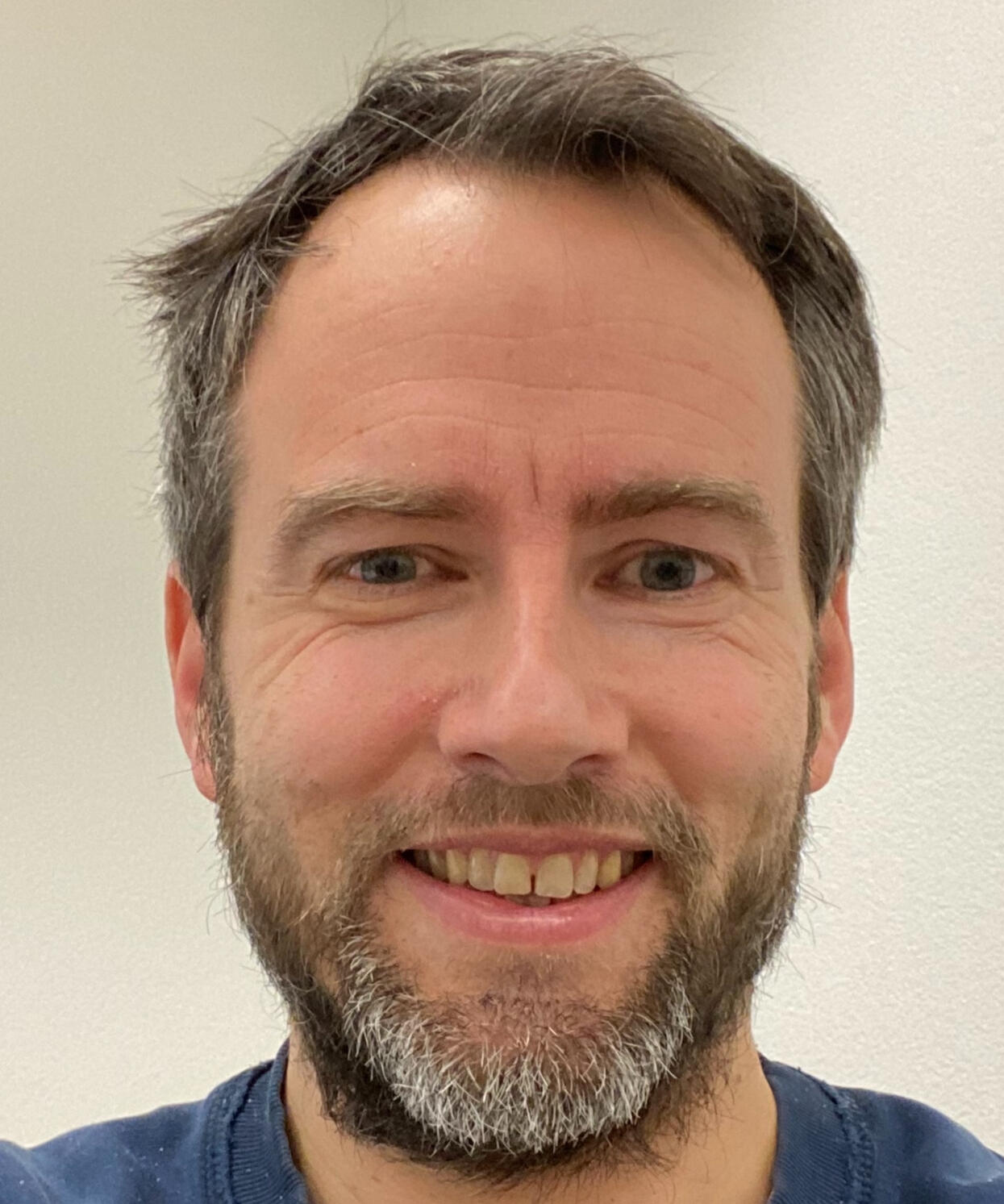
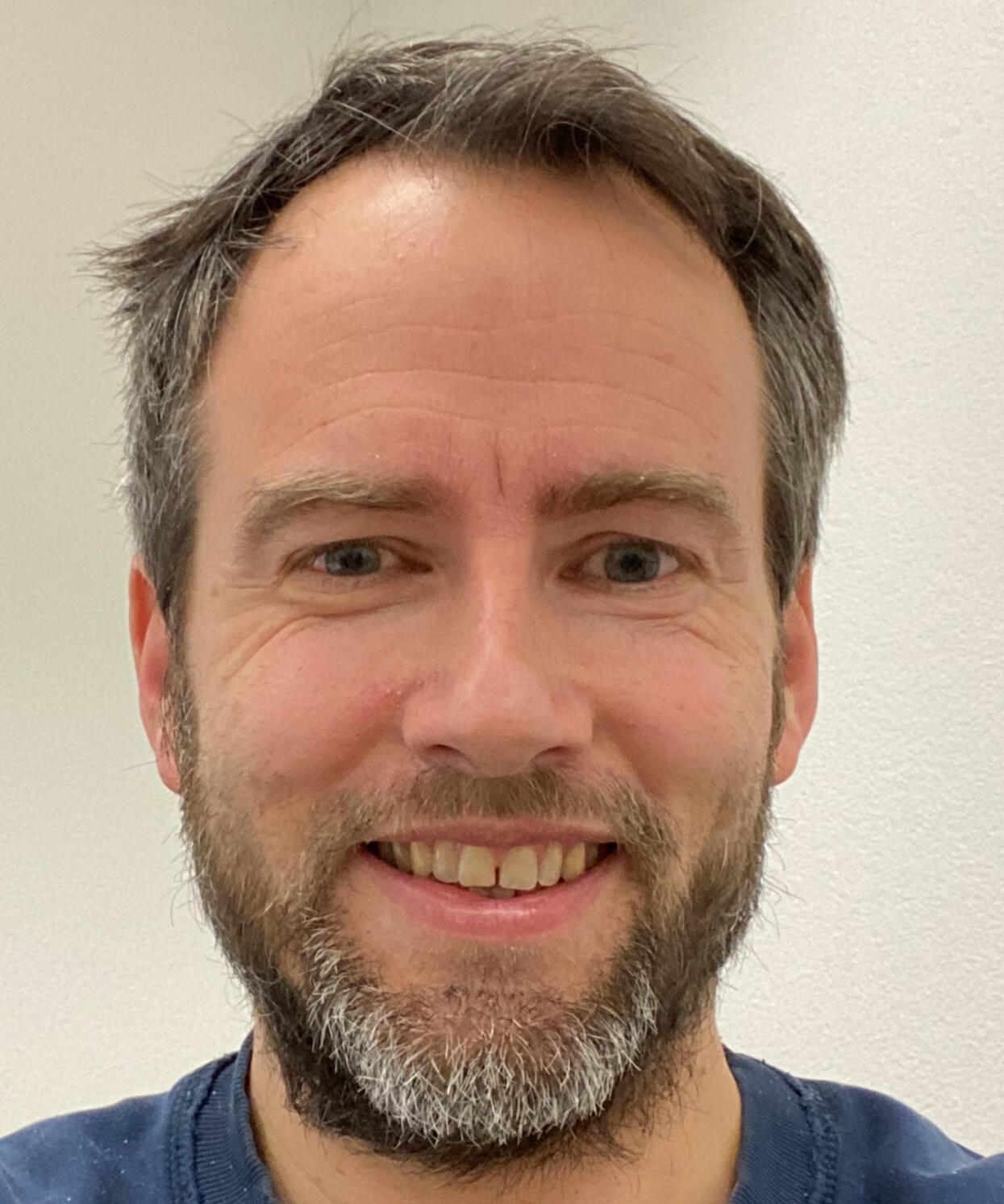
I don’t know who I am. And this is for me the most honest place to begin. Who I am cannot be captured in a definition. What moves through me is not something that can be held in words.What I can share is the path life has walked through me. The questions, the moments, and the shifts that shaped how I meet the world today.My name is Sebastian. I’m 49 years. Together with my wife Gina and our 4 children I live in Norway, in the middle of nature, at the end of a 2 km private road, surrounded by forest on one side, and a panoramic view across lake Mjøsa, Norway's largest lake, on the other side. Silence still speaks here.Much of what I now understand began long before I had words for it.When I was 4 years I refused to accept the idea that the opposite of “small” is “big,” sensing already that reality isn’t built from opposites but from perspectives. At age 5 I spent months contemplating whether nothing could be something. The idea of nothing used to make me feel very uncomfortable. When I finally concluded that nothing contains actually everything, something in me relaxed, and the discomfort vanished.In my teens I was drawn to natural philosophers like for example Heraclitus, who said that everything flows and nothing stays the same. This mirrored what I believed and still believe: life is movement, not structure. I noticed that life unfolds by itself.Through the years I became more and more aware that words are just secondary; the energy underneath them tell the real story. Often the words and the energy don't match. This used to confuse me. Now I hear what is not said, and I trust what I feel. I trust my intuition.A turning point came in 2006 when I spent a couple of days in a silent monastery. In the silence something became very clear to me. I read the following line in the Bible: “Do not worry about tomorrow… look at the birds; they do not plan ahead, yet they are taken care of.” In that very moment the future that I tried to control for so long stopped being a threat. Fear dissolved. I stepped through a wall of insecurity I had carried since childhood but was unaware of. The day after I left my job and began working for myself: Biloxi was born. Not as a plan, but as a natural continuation of that moment of trust.In 2019, Gina and I followed an inner calling and moved from the Netherlands to rural Norway. Here, surrounded by nature, silence, and space, life began to feel more in alignment with my life purpose again.
We both share a deep interest in trauma healing and energy work, and we have experience with IOPT, tantra yoga, and coaching.Today, my work is simple: I offer presence. I offer space. A place where people can slow down enough to meet themselves honestly, without force, without expectation.When the mind becomes quiet, the body speaks. When the unconscious becomes conscious, life reorganizes itself. When we allow ourselves to feel what we have avoided, something in us begins to flow again.My role is not to tell you who you are. It is to support you as you remember it yourself.

What I offer
1. One-on-one coaching
A quiet, grounding space where you can slow down, feel what is happening inside of you, and bring awareness to the unconscious patterns, beliefs, and emotions shaping your life.
→ Click here for more information2. Tantra massage
A respectful form of touch that helps you feel, soften, and reconnect with your body. The body remembers what the mind has forgotten. Through presence and breath, blocked energy begins to move again, allowing release, openness, and renewed vitality.
→ Click here for more information

1. One-on-one coaching
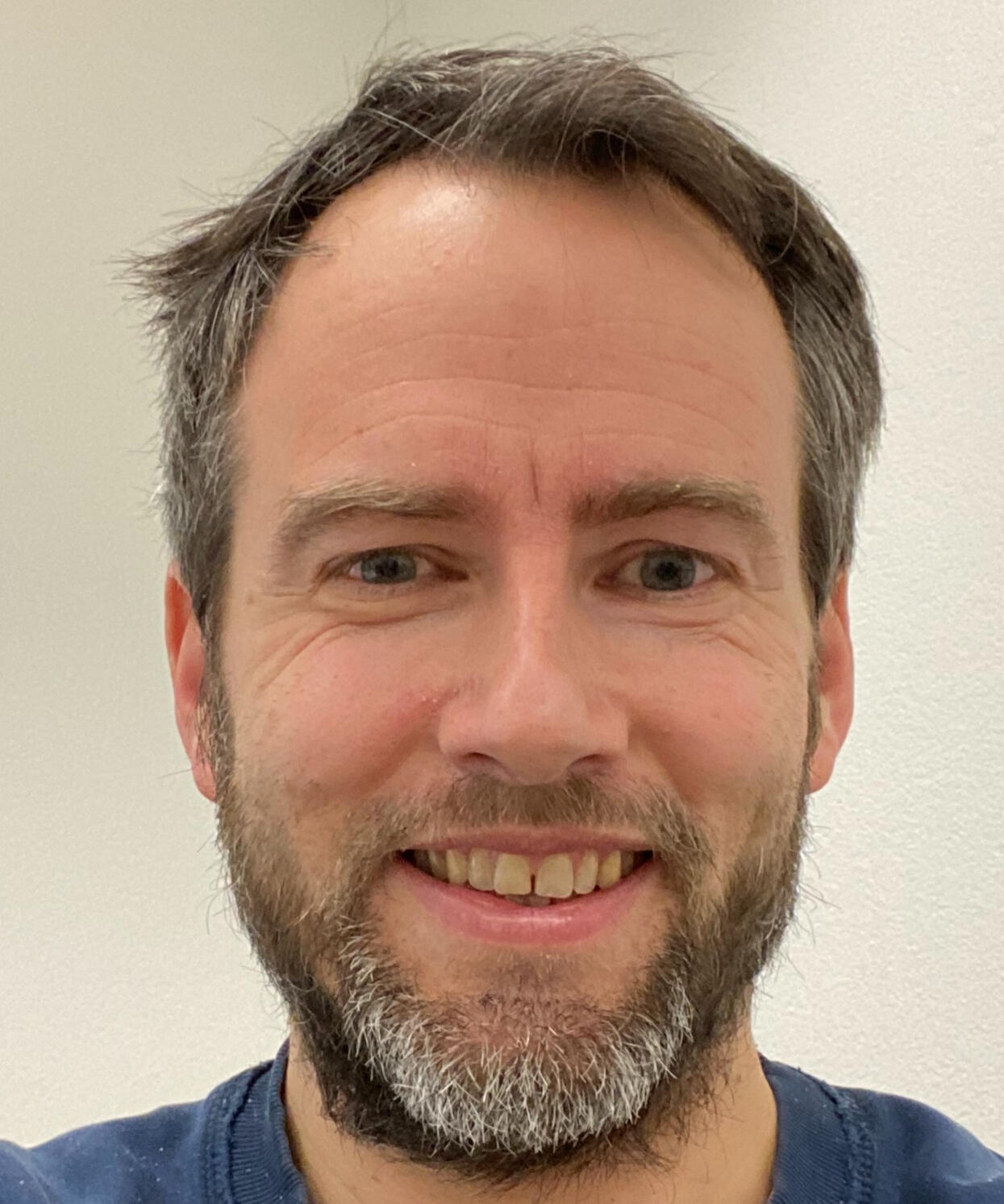
One-on-one coaching with me is a quiet, grounding space where you can slow down, feel what is happening inside you, and bring gentle awareness to the unconscious patterns, beliefs, and emotions shaping your life.Together, we explore your inner landscape with presence and curiosity. Not to fix you (you are not broken!) but to help you see what has long been unseen, feel what has long been unfelt, and reconnect with the truth of who you truly are beneath all the layers of conditioning.Sessions can help you with:
• Internal conflict
• Emotional clarity
• Relationship dynamics
• Boundaries
• Anxiety
• Life transitions
• Returning to yourself

How I work
My way of working is simple, direct, and rooted in presence. I don’t offer quick fixes, predefined steps, or scripted tools. Instead, I meet you exactly where you are — without judgment, without expectation, and without an agenda for who you “should” be.Our work together begins with slowing down and becoming honest about what is happening in your inner world. We explore what feels alive, what feels stuck, and what life seems to be asking of you right now. I listen closely — not only to your words, but also to the deeper layers beneath them: the emotions, patterns, beliefs, and unspoken longings that shape your experience.Transformation, as I see it, unfolds naturally when we bring awareness to these deeper layers. It is less about “fixing” and more about seeing clearly, and from that clarity, discovering new ways of relating to yourself, others, and life.To guide this exploration, I often work with a framework I developed over many years: The Cycle of Change. It describes four natural states we move through when life invites us to grow — Comfort, Crisis, Courage, and Competence. Understanding where you are in this cycle helps us see your situation with more compassion and clarity, and it reveals what is needed next in your process.Working with me is an active, embodied process. We might explore emotions, patterns, trauma responses, or long-held beliefs. We may sit with silence, question assumptions, zoom out to see the broader picture, or zoom in to meet younger parts of yourself that were once overwhelmed. Together, we unlearn what no longer serves you and open space for something more authentic to take form.I do not lead you — I walk with you.
You set the pace.
You choose the depth.
You follow what feels true.My role is to mirror, to sense, to bring clarity, and to help you stay connected to what is real in you, even when it feels uncomfortable or uncertain. Through this practice, new insights emerge, new capabilities grow, and life begins to shift — not by force, but through awareness, honesty, and courage.Ultimately, my work is about helping you return to yourself.
And from there, finding the next step that aligns with who you truly are.


Where I live
Together with my wife and our 4 children we live on the countryside in Eastern Norway, at the end of a 2 km private road, on top of a hill (550 masl) with on one side a breathtaking panorame view over Mjøsa, Norway's largest lake, and on the other side forest. No direct neighbors, except wildlife. Often we see deer, mooses, squirrels and foxes. It's quiet and peaceful up here, a place where silence still speaks.

The Cycle of change
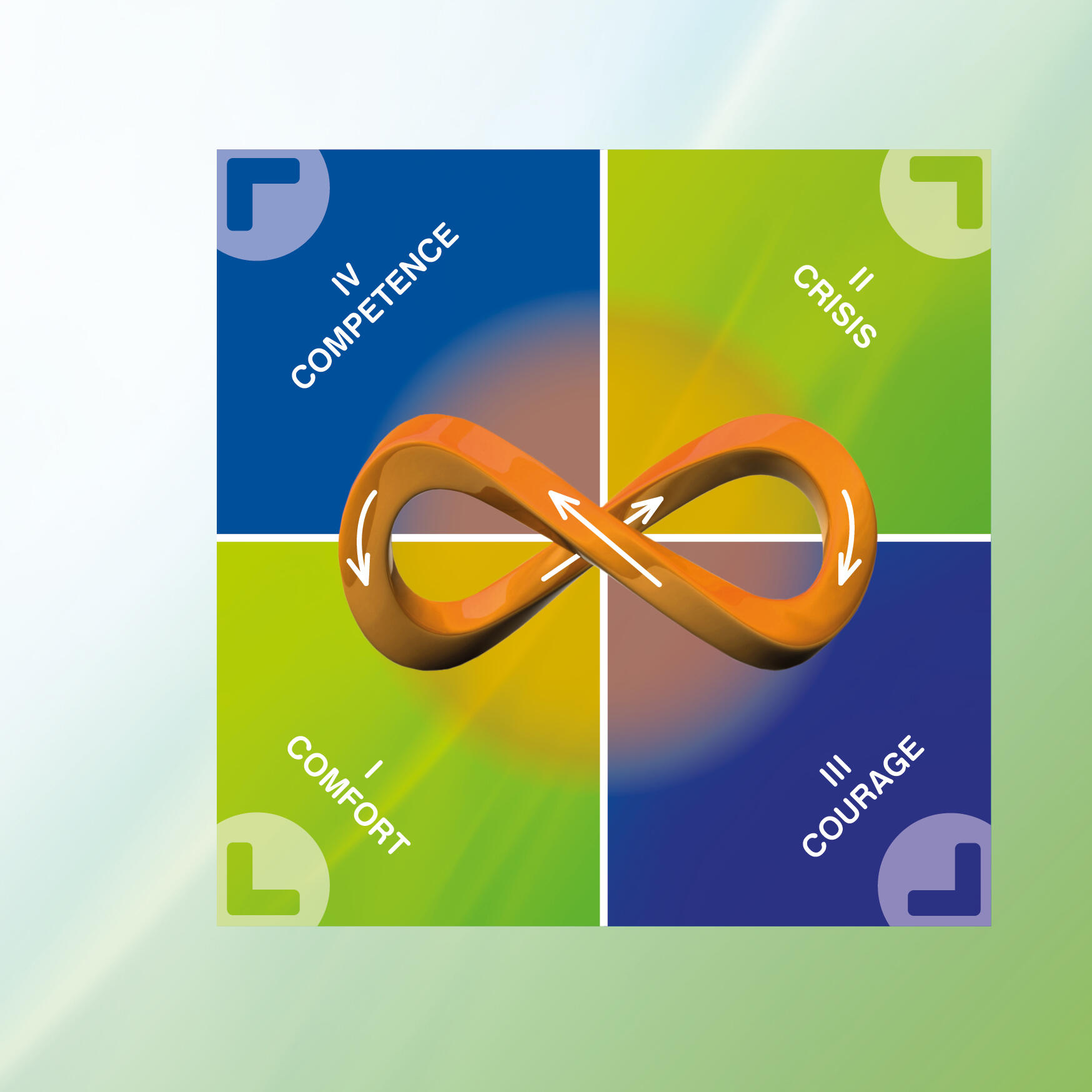
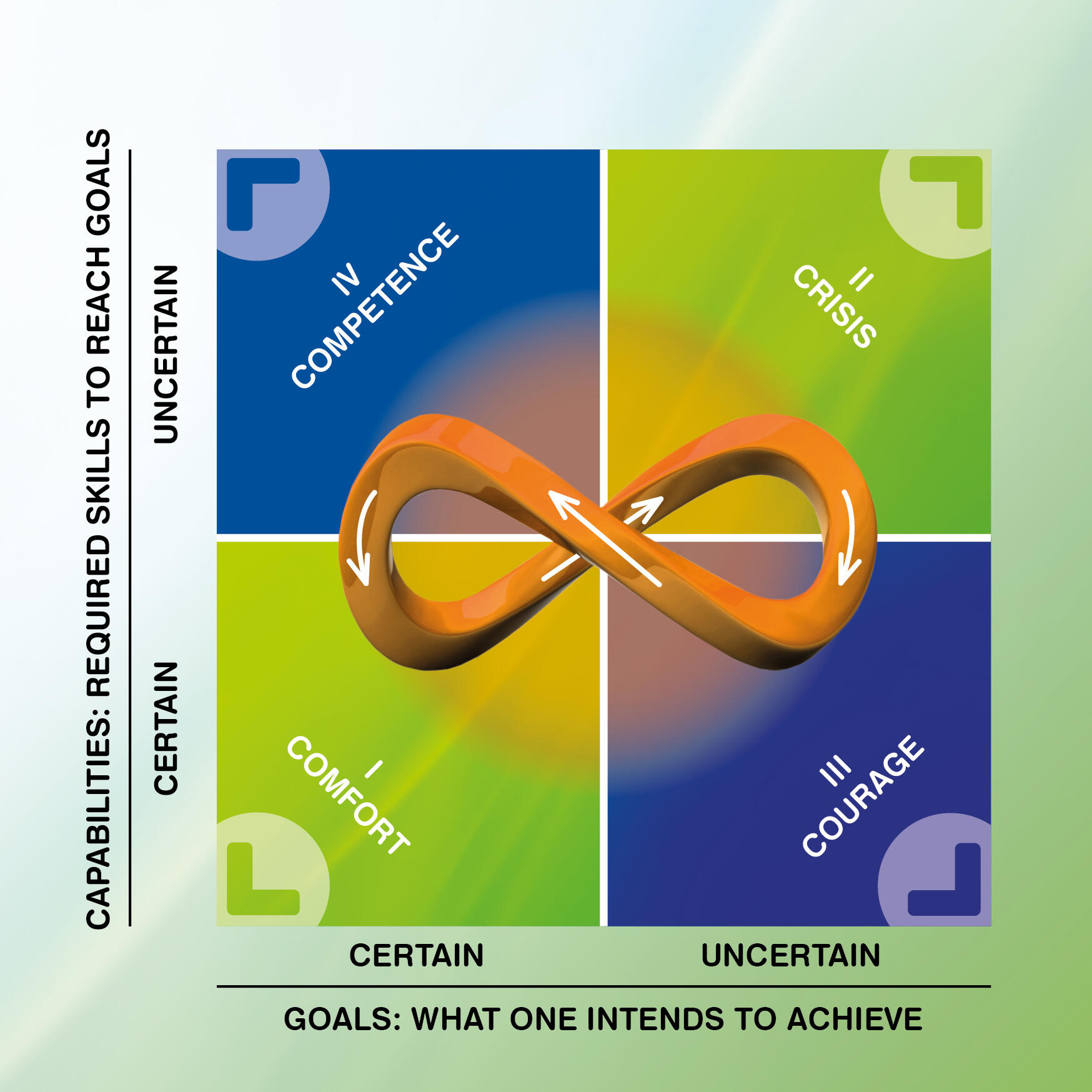
You may be here because something in your life feels out of sync. Perhaps circumstances around you are changing and you sense you need to adapt. Or maybe you have grown internally, by doing the inner work, and you feel you've outgrown the life you’re living.Either way, you’re noticing a discrepancy between where you are and where you want (or need) to be. There is nothing wrong with you, nor with the situation. It is life inviting you to evolve.Throughout the years I developed a practical model that explains transformation: the cycle of change. It is a simple, clear framework to help you understand the situation you are experiencing, without judgment. It reveals the underlying structure of human change so you can move through your experience with clarity and compassion.The Cycle of Change describes four natural states we move through again and again:
1. Comfort: When life feels familiar and in control
2. Crisis: When life feels out of control and unfamiliar
3. Courage: When you find the courage to explore other ways
4. Competence: When new ways of being take rootSometimes life pushes us out of our comfort zone through external events (for instance because of loss, illness, or conflict). Sometimes it starts from the inside (healing, a deeper truth emerging). Either way, the same pattern appears.Step by step I will explain the model. I'll start with the 2 axes that define the 4 states.

two dimensions
The Cycle of Change is built on two simple yet powerful dimensions: your goals and your capabilities.
Both of these can feel either certain or uncertain, depending on where you are in life.Two dimensions
1. Goals: This axis reflects how clear your direction feels.
2. Capabilities: This axis reflects how equipped you feel to meet what life brings.About Goals
When goals are certain, you know what you want, where you’re going, or what matters to you. When goals become uncertain, your sense of direction blurs. What used to feel meaningful may no longer fit, and the future feels undefined.About Capabilities
When capabilities feel certain, you trust your skills, strengths, and resources. However, when capabilities feel uncertain, you may feel unprepared, overwhelmed, or unable to respond the way you normally would.The degree of uncertainty
Both axes exist on a spectrum. You rarely feel 100% certain or 100% uncertain. But the more uncertainty you experience in both your goals and your capabilities, the more intense the inner experience becomes.At mild levels, you may feel stretched, restless, or confused.
At very high levels of uncertainty, when both your direction and your capacities feel unclear, the experience can feel overwhelming, as if the ground beneath your feet is disappearing.Four states
As these two axes intersect they create four states. The combinations form the four natural states of the Cycle of Change:
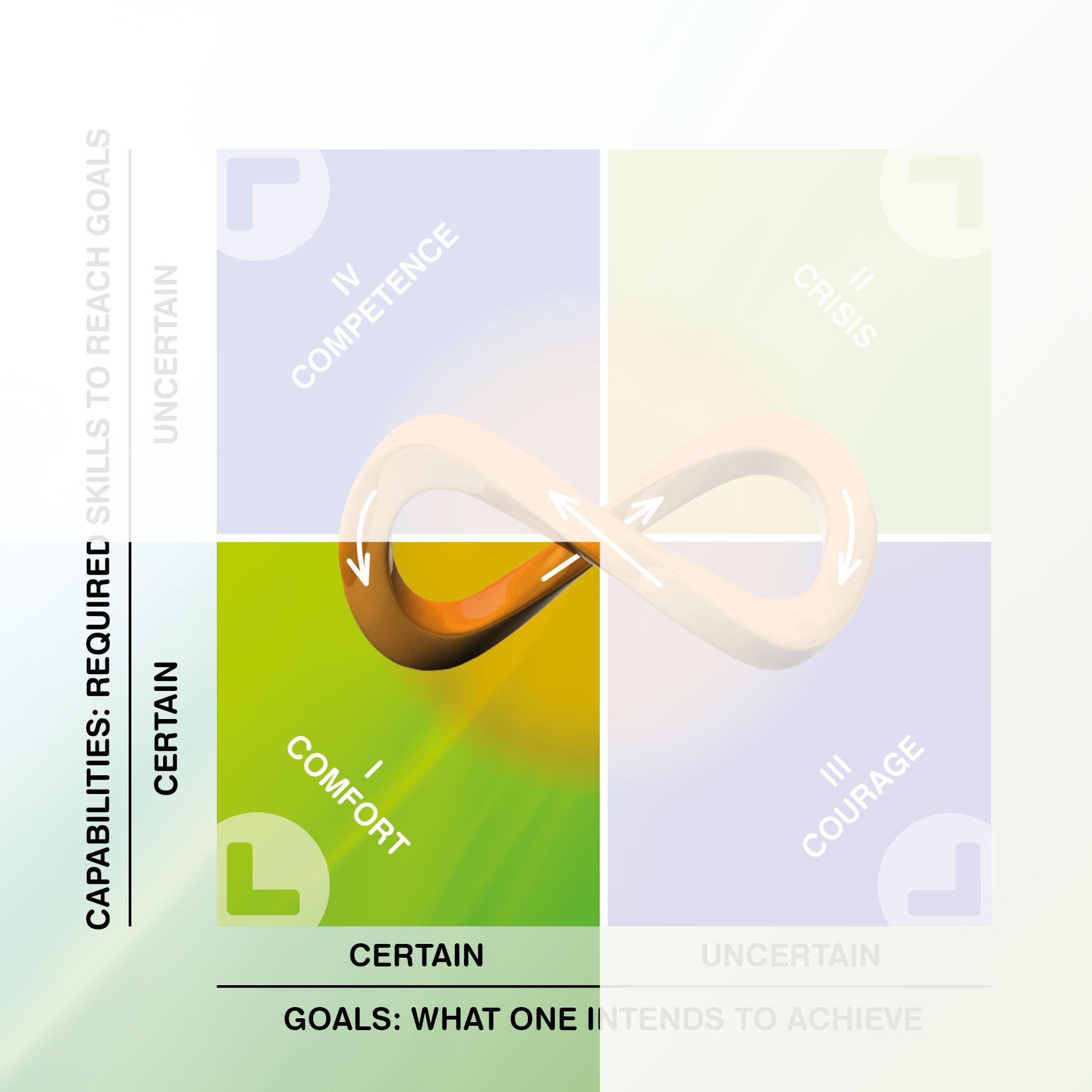
1. Comfort: Goals certain & Capabilities certain
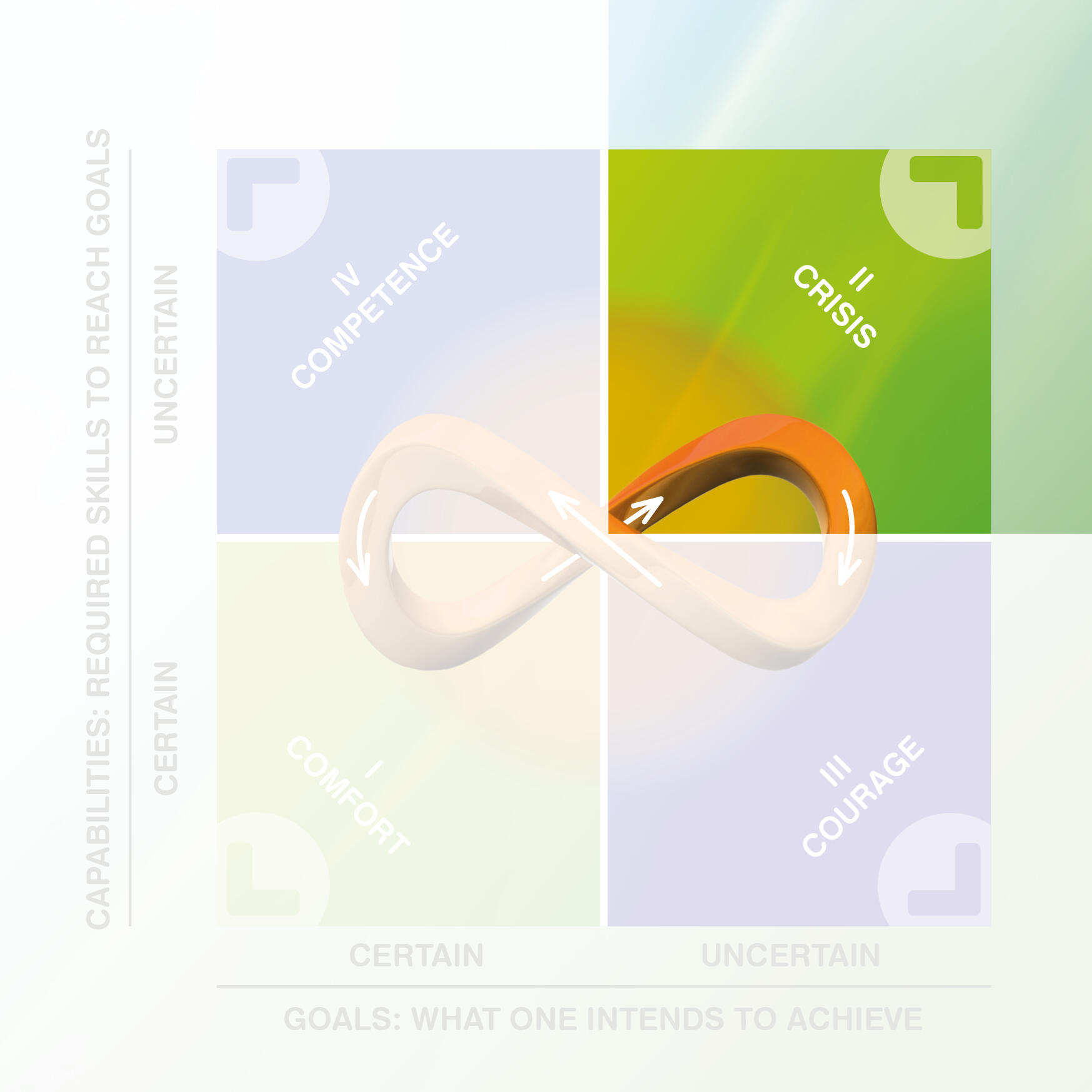
2. Crisis: Goals uncertain & Capabilities uncertain
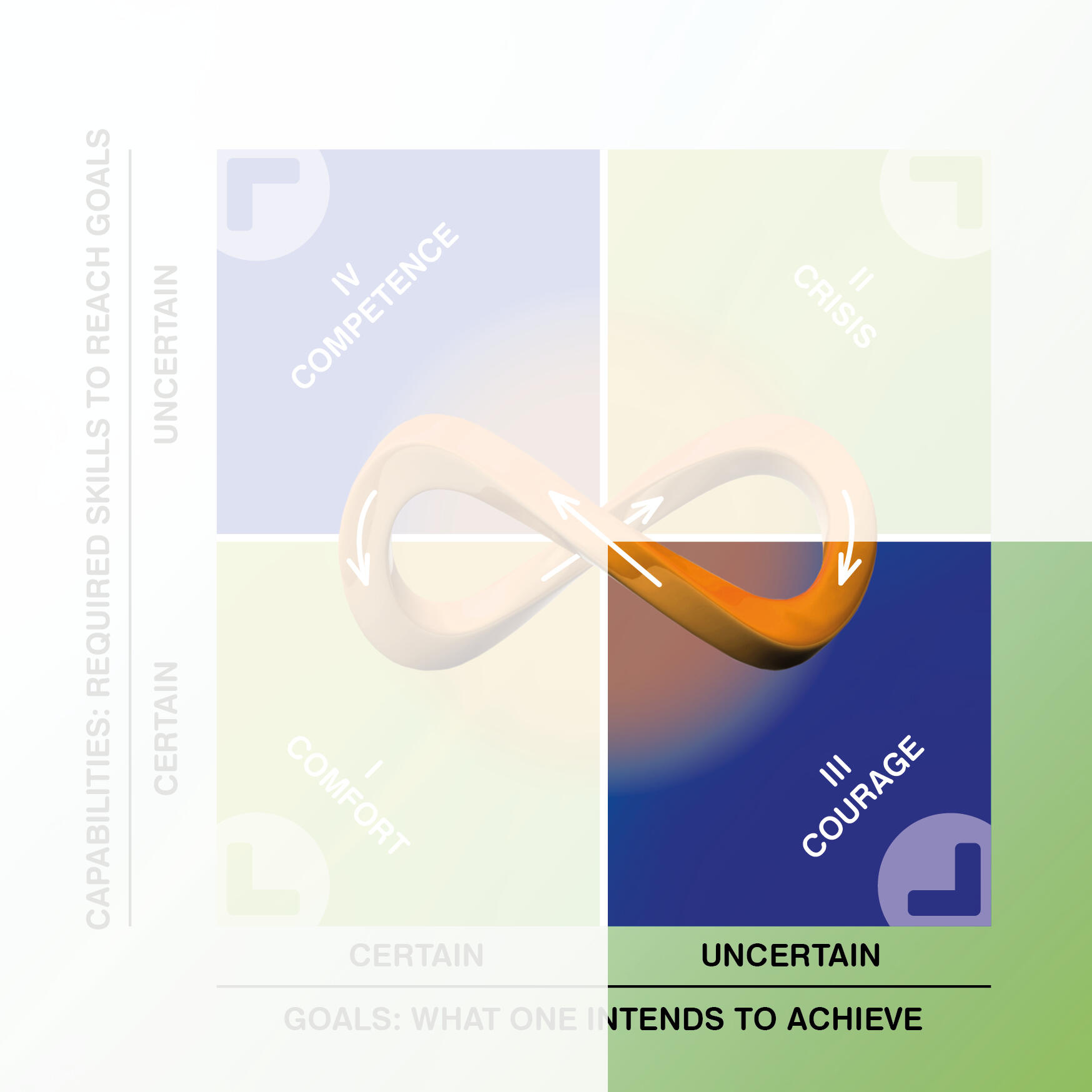
3. Courage: Goals emerging & Capabilities uncertain
4. Competence: Goals certain & Capabilities emergingEach of these four states represents a different inner experience of change. Let's go to the first state: Comfort.

1. Comfort
In the state of Comfort, both your goals and your capabilities feel certain. You have a clear sense of what you’re doing, why you’re doing it, and how to handle most situations. Life feels familiar, stable, and predictable. Your routines, roles, and habits provide consistency and continuity, and things function in a way that feels manageable, sometimes even effortless.Comfort can feel like contentment: a place where you can rest, breathe, and settle. It offers grounding, containment, and a sense of being in control of your life.Yet even inside Comfort, subtle signs of change can begin to appear. A faint restlessness. A quiet sense of limitation. A whisper that something no longer fits as well as it used to. These small shifts are often the first signals that life, either internally or externally, is beginning to move.You might notice:
- Subtle boredom, restlessness, or lack of aliveness
- A feeling that you’ve stopped growing or expanding
- A quiet curiosity emerging, even if you’re not acting on it yetAs time passes, change becomes inevitable. Life evolves, circumstances develop, relationships change, and responsibilities grow. When the world around you moves in a new direction but your inner perception or way of responding does not adapt, the familiar terrain of Comfort begins to feel less and less comfortable. What once felt stable may start to feel tight, outdated, or misaligned. Tension appears. The gap between who you are now and the life you are living slowly widens.Sometimes this transition is slow-paced: a sense of discomfort, a pull toward something new. Other times the transition comes unexpectedly, and more intense. Whether it comes slow or fast, the transition is leading into the state of Crisis, where both your direction and your capabilities feel uncertain.Let's explore this next state: Crisis.

2. Crisis
In the state of Crisis, both your goals and your capabilities feel uncertain. The clarity you once had dissolves. What used to make sense no longer fits. A crisis is, above all, an inner experience — not an objective fact. What feels overwhelming to you might be manageable for someone else, and vice versa. It is the loss of orientation and stability that defines this state.A crisis can arrive unexpectedly and very rapidly — a piece of news, a sudden change, a shock. For example: you are fired or let go, your partner ends the relationship, a loved one dies, or your health shifts without warning. But crisis can also develop slowly and quietly. You may simply realise that who you are has outgrown the life you are living. Meaning fades, direction blurs, and something inside you collapses without anything dramatic happening on the outside.In Crisis, life feels chaotic or overwhelming. The ground beneath your feet seems to move. You may feel lost, anxious, stuck, or “between worlds,” as old ways of coping no longer work and new ones have not yet formed.Because this state is so uncomfortable, our natural reaction is to resist it. We label the situation as a problem, try to regain control, or attempt to push life back to how it used to be. But trying to control outer circumstances takes enormous energy — and often increases the tension. A more courageous movement is to turn inward and ask: Why is this affecting me so deeply? What in me experiences this as a crisis?When we dare to look inside, we often discover that the intensity of the moment touches something older. The body and nervous system remember experiences from childhood that were too overwhelming to process at the time. These memories were pushed away into a kind of inner Pandora’s box to keep us safe — but keeping the lid closed costs energy, creativity, and aliveness. Life invites us to open that box, not to harm us, but to free us. And opening it requires courage, which is one reason people often stay in old patterns: even dysfunction can feel familiar and therefore safe.Even though Crisis is painful, it plays a vital role. It exposes what no longer matches your growth and makes you aware of where your life has fallen out of alignment. Crisis disrupts outdated structures and clears the space for a more authentic next step — long before you know what that step will be.When your resistance softens, even just a little, a new possibility appears: the willingness to explore. The first spark of curiosity. This marks the beginning of the next state in the model: Courage.
3. Courage
Courage begins at the moment when the intensity of Crisis softens just enough for you to stop resisting what is happening. You are not yet clear, not yet confident, but something in you becomes willing. A small inner shift occurs: instead of fighting reality or trying to return to the past, you start turning toward what is here now. Courage does not mean the absence of fear; it means moving gently even while fear is still present.At this stage, your goals are only beginning to emerge. You do not yet know exactly where you are going — you simply sense that the old direction is no longer valid. This first willingness is subtle and often quiet. It may appear as a single question, a fresh perspective, or a moment of curiosity. Yet this tiny movement marks the beginning of transformation: a transition from holding on to letting go.Because nothing is fully formed yet, the state of Courage is a phase of exploration. You are stepping into the unknown, without clear reference points or guarantees. You experiment. You try something, observe, adjust, and try again. This is a period of trial and error, and it is important to remember that this is not failure but a natural part of learning. You discover what resonates and what doesn’t. This stage can feel unsteady or confusing, not because you are doing something wrong, but because you are navigating a reality that is genuinely new.It is completely normal to move back and forth between Courage and Crisis during this phase. Change rarely unfolds in a straight line. What matters is not perfection, but the willingness to return to exploration each time you drift back into old fears or patterns.As a new goal or direction begins to take shape, another realisation often follows: new capabilities are required to move toward it. You see that who you have been is not yet equipped to live the life that is calling you. This can be both inspiring and confronting. Courage therefore involves more than finding a new direction — it also requires the willingness to reinvent yourself. You gradually unidentify from an older identity and begin to step into a more authentic one. This inner reshaping makes this phase challenging; transformation is not only conceptual but embodied.Because of this vulnerability and uncertainty, the pull of the past can still be strong. Part of you may want to return to what is familiar, even if it no longer fits. This backward movement is natural, but Courage invites something different: a gentle commitment to keep moving forward, even without certainty and even without solid ground under your feet.You might notice:
- A growing curiosity about what could come next
- The courage to take small steps without knowing the outcome
- A willingness to ask for help or explore new options
- Breakthroughs mixed with insecurity or doubt
- The first sense of possibility returningTo stay in Courage requires time, patience, determination, trust, and surrender. Patience, because change unfolds at its own pace. Determination, because old patterns pull strongly. Trust, because the outcome is still unknown. And surrender, because you cannot control the timing or shape of what emerges.As you continue exploring, experimenting, failing, learning, and adjusting, something begins to take shape within you. Your direction becomes clearer, and with that clarity you also begin to see the capabilities required to move toward your new goals. You start taking steps in that direction — sometimes small, sometimes hesitant — and each one strengthens your alignment with what is emerging.Slowly, the uncertainty that defined Courage gives way to a growing inner confidence — a sense that you are no longer merely searching, but beginning to follow a path that feels increasingly true.This strengthening marks the transition into the next state: Competence — where new ways of being begin to take root and become embodied.

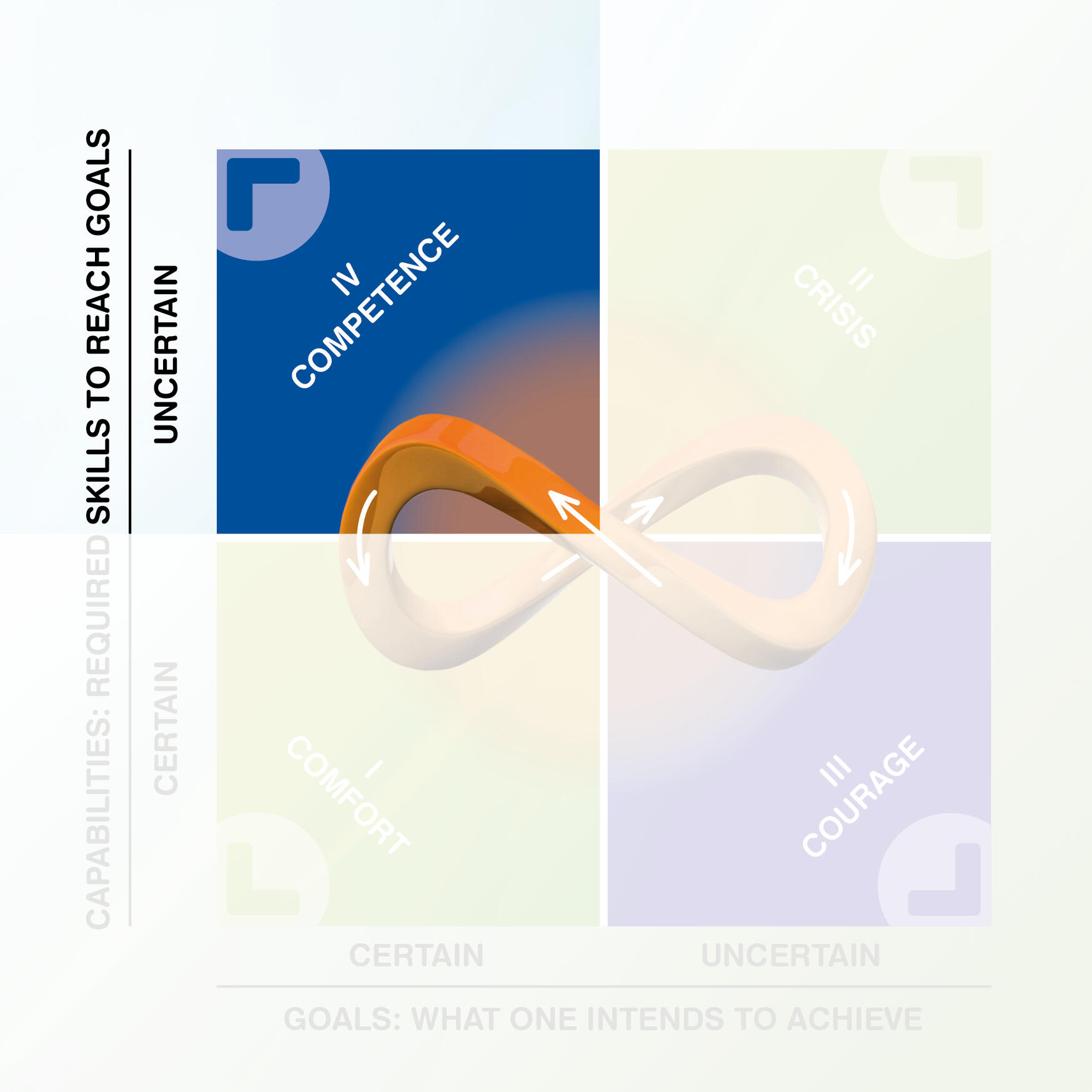
4. Competence
Competence is the state in which the direction that emerged in Courage becomes clearer and begins to stabilise. You now have a sense of where you are going, and your capabilities — though still developing — are growing to meet that direction. What once felt unfamiliar starts becoming natural. What once required effort begins to feel more embodied.In this state, you are learning to live from a new way of being. You practise different behaviours, cultivate new perspectives, and strengthen the emotional and practical skills needed to move toward your goals. The uncertainties of Courage give way to a more grounded sense of “I can do this.” It doesn’t mean everything is easy or complete — but you are no longer wandering. You are applying, integrating, and growing.At the same time, this phase can also feel challenging and frustrating. Competence requires you to unlearn old ways of thinking, responding, and behaving, while simultaneously learning entirely new ones. This process naturally involves trial and error — many attempts, many adjustments, moments of progress followed by setbacks. It is not a sign that something is wrong; it is simply the reality of integrating change.For some people, this might mean learning new communication skills, practising boundaries, or building emotional regulation. For others, it may involve professional growth — taking a course, changing roles, or developing entirely new competencies. Whatever the context, Competence requires repetition, experimentation, and patience.New capabilities do not develop overnight. They need time, repetition, and practice. Sometimes this phase even requires formal education, specialised training, or long-term development to build the skills your new direction demands. Competence is not just an inner shift; it is the steady work of embodying a new way of living. Although demanding, each effort strengthens your alignment with who you are becoming.Competence often feels energising. You start seeing progress, noticing results, and experiencing the first signs of alignment between your inner world and your outer life. New habits begin to form. New responses become available. Where you once fell back into old patterns, you now pause, choose differently, and move forward with more clarity and intention.You might notice:
- A clearer sense of direction and purpose
- Growing confidence in your abilities
- New habits forming naturally over time
- More stable emotional responses
- A sense of alignment between who you are and what you do
- Increasing trust in yourself and in lifeYet even in Competence, the pull of older patterns can occasionally return. This is natural. Growth is not linear, and moments of doubt or regression simply show where integration is still unfolding. The key is not to interpret these moments as failures, but as part of the rhythm of learning. Competence strengthens through practice, consistency, patience, and compassion toward yourself.As your new skills deepen and your identity solidifies around a more authentic way of being, life begins to feel more stable and congruent again. You’re not back in the old Comfort — you’ve arrived at a new Comfort, one that reflects who you have become rather than who you once were.This completes the cycle: from Comfort, through Crisis, into Courage, and into Competence — eventually arriving at a higher, more authentic level of Comfort. From here, life will continue to evolve, and the cycle will naturally repeat itself whenever your next chapter of growth begins.

Contact
Lorem ipsum dolor sit amet, consectetur adipiscing elit. Praesent vestibulum risus sit amet lectus condimentum, ac fermentum nibh ullamcorper magna.
Thank you
Lorem ipsum dolor sit amet, consectetur adipiscing elit. Praesent vestibulum risus sit amet lectus condimentum, ac fermentum nibh ullamcorper magna.